0800 046 1000
Plumbing
Heating

Reactive Maintenance Only Looks Cheaper Until the Invoice Arrives

Pleasant Plumbers are a trusted, vetted team of experienced Commercial Plumbers and Commercial Heating Engineers in London. Trusted by FM teams, Property Managers and Landlords.

The one attraction of reactive maintenance; Why the "Nx more expensive" figures are unreliable; The emergency premium; Parts bought in a hurry; When the failure doesn't stop at the failed part; Run-to-failure shortens asset life; The compliance clock; What to actually calculate

Reactive maintenance has one genuine attraction, and it is worth stating honestly: you only pay when something breaks. There is no standing cost, no schedule of visits, no annual commitment. On this year's budget line it looks like the lean option, and for genuinely low-criticality items — a door closer, a light fitting, a tap washer — running an asset to failure is a perfectly rational choice. The mistake is applying that logic to the plant that heats the building and moves its water, where the economics quietly invert.

There is a maintenance industry fond of a single number — reactive work costs three times planned, or five times, or 194% more — and the honest position is that these figures are unreliable. They circulate between maintenance providers without a clean source, the multipliers contradict each other, and most come from firms selling the planned alternative. The case for planned maintenance on heating and water plant does not need a borrowed statistic. It is better made by looking at what actually happens, cost by cost, when a commercial boiler or a pump or a hot water system fails unplanned rather than being serviced before it does.

The emergency premium is real and quantifiable.

A planned service happens in daytime hours, at standard rates, by an engineer who arrived expecting the job. An unplanned failure happens whenever it happens, which for heating plant is disproportionately a cold morning or a weekend, and it is met at out-of-hours rates. Overtime on commercial M&E work commonly runs at one and a half to two times the standard rate, and a London out-of-hours boiler call-out can carry a charge in the region of several hundred pounds before any labour or parts are added. The same repair, in other words, costs materially more purely because of when it is forced to happen.

Parts bought in an emergency cost more and arrive slower.

Planned replacement lets a part be sourced competitively on a normal lead time. The same component needed urgently, to get heat or hot water back into an occupied building, is bought on expedited delivery at a premium, sometimes a steep one, and occasionally substituted for whatever is available rather than what is ideal because the building cannot wait. The procurement saving that planned work captures simply by not being in a hurry is invisible on any single invoice, which is precisely why it is underrated.

The failure rarely stops at the failed part.

A boiler that fails mid-winter does not just need a boiler repair; it may need temporary heat hired in while it is fixed, and a hot water failure in an occupied building is a continuity problem before it is a repair. A leak from a neglected joint damages whatever is below it. The cost of an unplanned failure is the repair plus the collateral — the business interruption, the temporary mitigation, the secondary damage — and that collateral is frequently larger than the repair itself. Planned maintenance is, in large part, the practice of stopping small predictable failures before they recruit those second-order costs.

Run-to-failure shortens the life of the asset you are trying to save money on.

Commercial plant that is serviced holds its efficiency and reaches the end of its design life. The same plant run without maintenance fouls, scales, and works harder to do the same job, burning more fuel along the way and arriving at replacement earlier. The saving made by skipping services is partly borrowed against the capital cost of replacing the plant sooner, which is a far larger number than the services would ever have been.

The compliance clock does not stop because the budget is tight.
Much of what planned maintenance covers on heating and water plant is not optional upkeep but statutory: commercial gas safety, Legionella control, the servicing records that demonstrate a duty is being met. A reactive regime that visits only when something breaks does not generate the evidence trail those duties require, so deferring planned maintenance does not only risk a failure — it can leave a compliance gap that exists whether or not anything has broken yet.

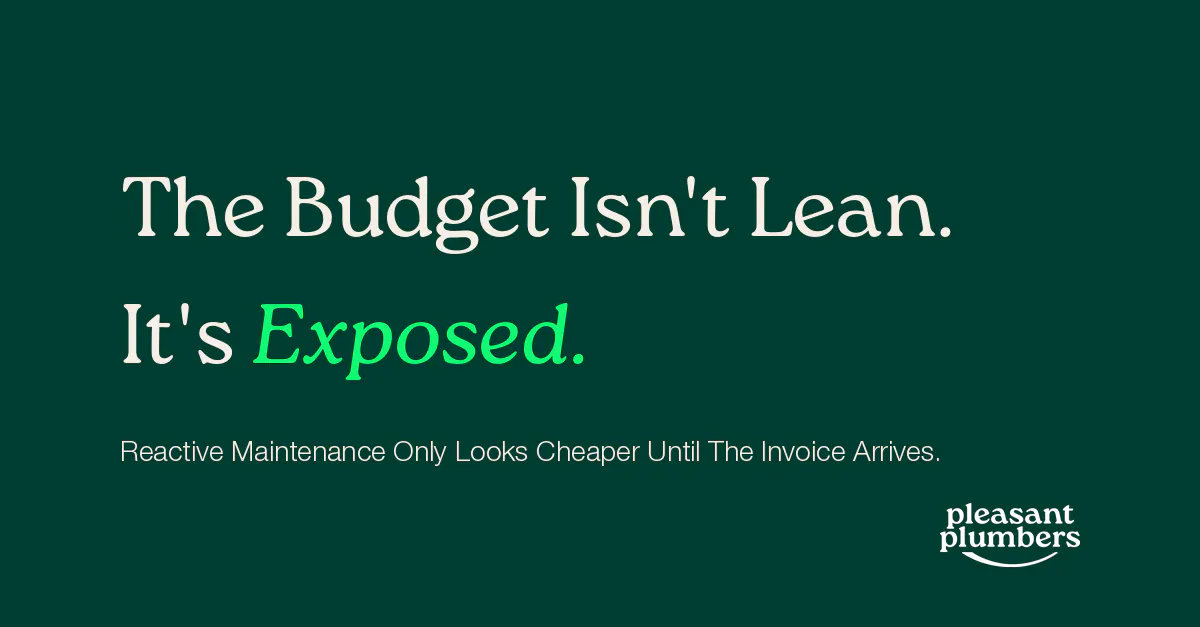
None of this argues for maintaining everything to the same intensity. The sound approach is the one well-run estates already use: planned maintenance concentrated on the critical and statutory plant — the boilers, the pumps, the hot and cold water systems, the gas plant — with reactive cover kept for genuinely low-consequence items. The recognised industry task schedules for this, published by BESA as SFG20, exist precisely to define what gets maintained and how often, and to flag which of those tasks are statutory rather than discretionary. The figure worth calculating is not someone else's multiplier but your own: what proportion of last year's heating and water spend went on emergencies rather than planned work. Where emergency work is a large share of the total, the budget is not lean, it is exposed.

For FM directors, building owners and the teams holding the maintenance budget, the run-to-failure approach to critical plant is not a saving deferred but a cost deferred, and usually enlarged in the deferral. The reactive invoice always arrives eventually, and it arrives at the worst time, at the worst rate, with the most attached to it.

Pleasant Plumbers' commercial team provides planned maintenance for commercial heating, hot water and gas plant across London — scheduled servicing that keeps the statutory records straight and keeps the emergency call-out the exception, not the model. To discuss a planned maintenance programme for your plant, call or WhatsApp 0800 046 1000, or email [email protected].

#FacilitiesManagement #CommercialHeating