Hot water is the one service in a commercial building where the design instinct and the right answer point in opposite directions. Faced with a hotel full of guests all showering between seven and nine in the morning, or a gym emptying into the changing rooms after an evening class, the natural response is to fit plenty of capacity so the building never runs out. That instinct, applied without a proper demand calculation, produces a system that is too big — and an oversized hot water system is not a harmless safety margin. It costs more to run, it degrades water quality, and it often drags a chain of other oversized plant along behind it.
The starting point is how commercial hot water is actually made, because the method shapes everything downstream. The traditional UK approach is the storage calorifier: a large cylinder with an internal coil, heated indirectly by the low temperature hot water circuit from the building's boilers, holding a substantial volume of hot water ready for use. Alongside it now sit direct-fired storage water heaters, which burn gas to heat their own stored water with fast recovery; plate heat exchangers, which transfer heat from the primary circuit to the domestic water almost instantaneously with little or no storage; and point-of-use heaters serving isolated outlets. The essential distinction running through all of them is between storage and recovery — between holding a reservoir of hot water ready to draw down, and heating water quickly as it is needed. Every commercial system is a balance of the two, and getting that balance right is the whole game.
That balance should be dictated by the building's actual demand profile, and this is where the two building types diverge. A hotel or a student block has a short, violent peak: almost all the day's hot water is drawn in a couple of hours, morning and evening, and very little the rest of the time. That pattern rewards storage — a reservoir large enough to cover the peak, refilled gently over the quiet hours. A hospital or a busy leisure centre has sustained demand spread across the day, which rewards recovery — the ability to heat water continuously at a high rate, with less need to store it. Size a hospital like a hotel and you store water you do not need; size a hotel purely on recovery and you may not keep up with the eight o'clock peak. The correct system is the one matched to the shape of the demand, not to a single headline figure.
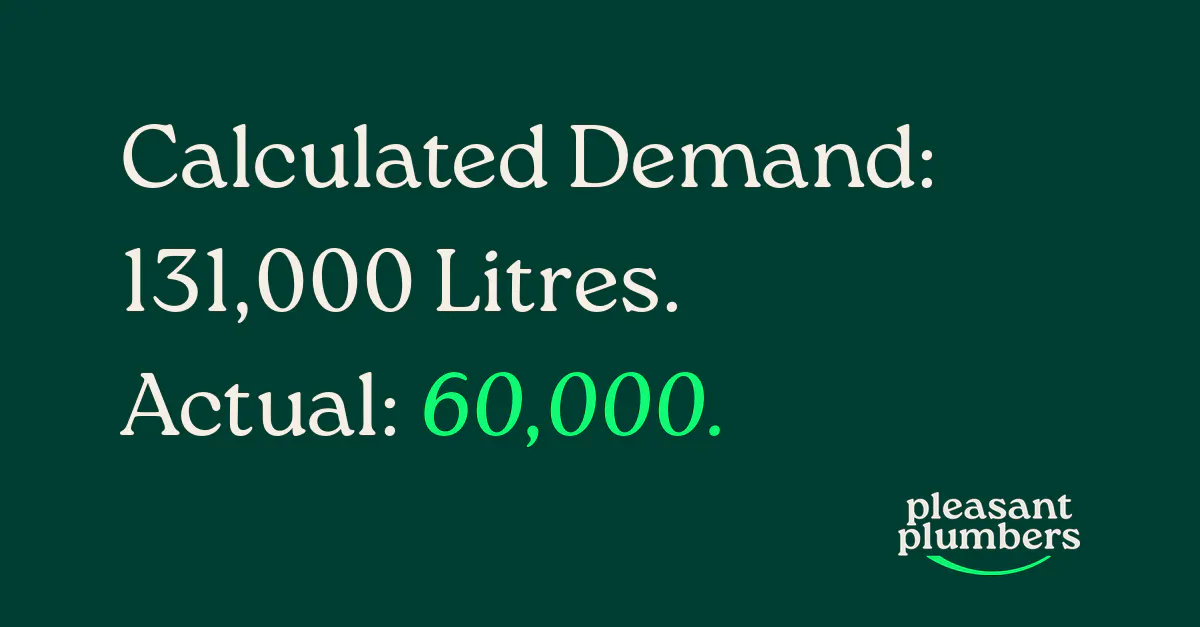
The problem is that the demand figure most systems are sized on is substantially too high. The traditional sizing methods, built on loading units and diversity factors from CIBSE Guide G and the CIPHE tables, were developed in an era of bulk storage and tend to be conservative, and each designer then adds a further margin of caution on top. The result is systematic oversizing, and in-use measurement bears this out. When Elementa Consulting monitored actual hot water use at two hotels for CIBSE, the gap was stark: at a large central London hotel, the standard calculation predicted around 131,000 litres a day against an actual average of about 60,000 — less than half the theoretical figure. At the second hotel, a family and spa hotel measured during a busy holiday period, real use ran around 55% below the standard prediction, and its cold water storage was turning over so slowly that it took more than two days to empty a tank. Two very different buildings produced the same finding: the calculation predicted roughly double the hot water the building actually used.
Oversizing on that scale is not a free insurance policy, because it carries three distinct costs. The first is energy. A large volume of stored hot water loses heat continuously through the vessel walls whether or not anyone draws it off, so a bigger store means larger standing losses, day and night, all year. Oversized generation plant compounds this, because a boiler or water heater selected for a peak the building never reaches spends its life modulating down to a fraction of its capacity, which is exactly where combustion plant runs least efficiently. The second cost is water quality, and it connects directly to Legionella. Hot water that sits in an oversized store turns over slowly, and slow turnover means water ages, stratifies and can drift out of the temperature regime that keeps it safe — the same stagnation risk that applies to oversized cold water storage, arriving here through the front door of a well-intentioned safety margin. The third cost is the chain reaction: an oversized hot water system implies oversized calorifiers, which imply oversized primary pipework and pumps, and often an oversized cold water booster set feeding it, each one carrying its own capital and running cost. The single decision to be generous with hot water capacity propagates through the plant room.
None of this argues for cutting it fine — a system that runs out of hot water at the morning peak is its own kind of failure, and genuinely variable or unpredictable demand deserves real headroom. The point is to size on the building's actual demand profile rather than on a conservative calculation stacked with safety factors: to identify the true peak hour and its real volume, choose the storage-to-recovery balance that suits that profile, and resist the reflex to round everything upward at each stage. Modern dynamic systems, which combine a modest store with high-rate recovery, are particularly hard to undersize and hard to oversize badly, precisely because they are designed around the peak rather than around a worst case piled on a worst case.
For FM directors, hotel and leisure operators, and estates teams specifying or replacing hot water plant, the useful question is not whether the system is big enough — it almost always is — but whether it is the right size for how the building actually uses hot water. The questions worth asking are what the real peak-hour demand is rather than the calculated one, whether the storage-to-recovery balance matches the building's demand shape, and whether an ageing oversized system is quietly costing money in standing losses and posing a water-quality risk that a right-sized replacement would remove. The hot water system that never runs out may simply be the one nobody has ever measured.
Pleasant Plumbers' commercial team carries out hot water system assessment, demand profiling and plant sizing for commercial buildings across London — matching generation and storage to how the building actually uses hot water, rather than to an oversized calculation.
To review your hot water plant, call or WhatsApp 0800 046 1000, or email [email protected].
#FacilitiesManagement #CommercialHeating