Heating
The BMS Doesn't Break Down. It Stops Doing Its Job.
Schedules that no longer match the building.Setpoints that have drifted, and overrides that quietly became permanent.Sensors that have stopped telling the truth
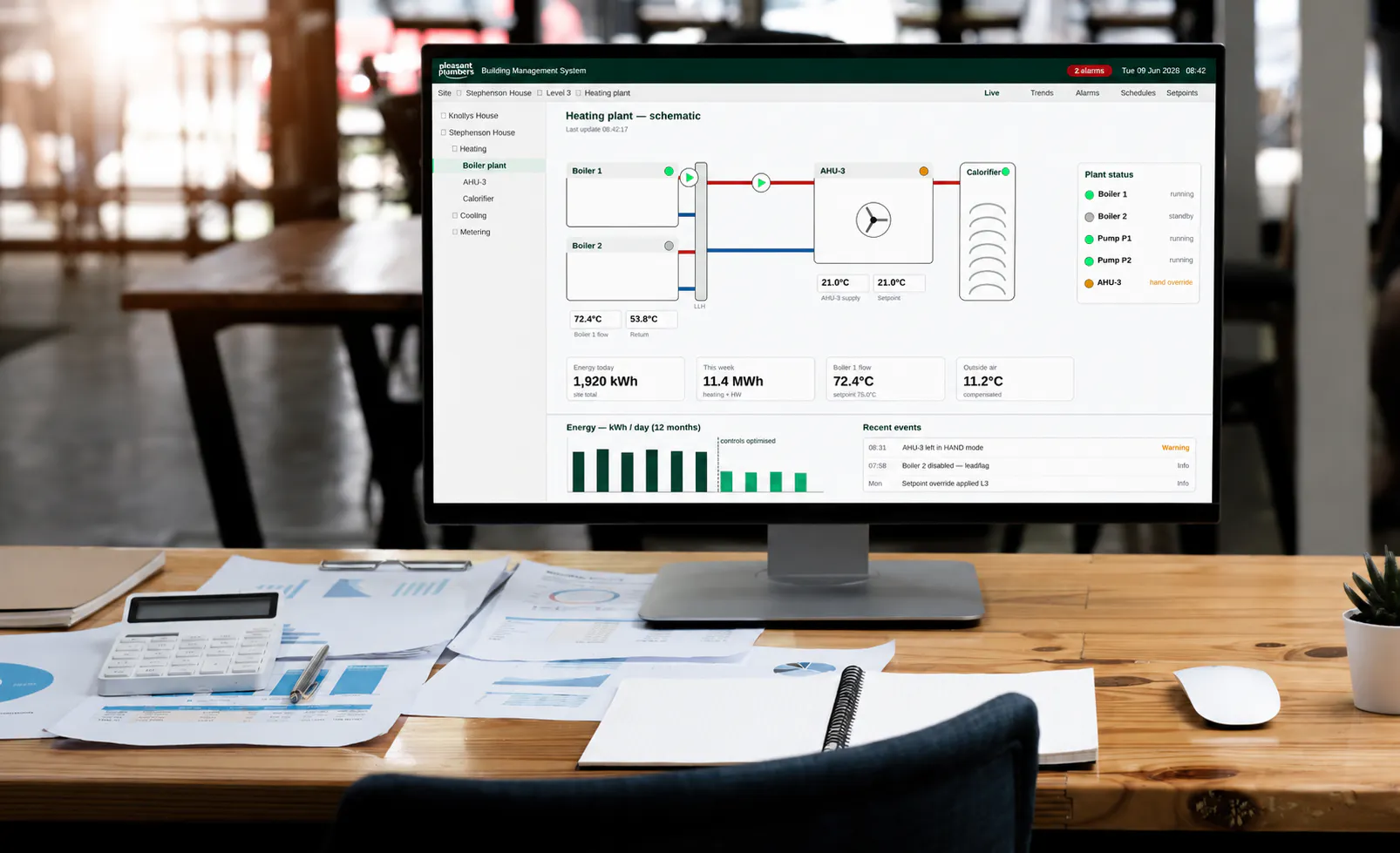
A building management system does not fail the way a boiler fails. There is no breakdown, no callout, no moment when it visibly stops working. It carries on holding the building at temperature, the tenants stay comfortable, the bills get paid — and in the background it runs plant the building no longer needs, on settings nobody has revisited since handover, responding to sensors that quietly stopped telling the truth two years ago. Nothing is broken. The building is simply being run badly, and the cost of that turns up only on the meter, where it is easy to mistake for the normal price of keeping the lights on.
This is a large cost in the right building. Heating, ventilation and air conditioning account for somewhere between 40 and 60% of a commercial building's total energy use, so the layer of logic governing that plant is one of the highest-leverage positions in the building — and the savings from putting it right are substantial for an intervention that usually involves no new equipment at all. A CIBSE Journal case study of a 17,600m² multi-tenanted office in Croydon recorded a 28% reduction in energy use and a £171,000 operational saving over nine months, achieved largely by reconfiguring how the building was controlled. King's College London has reported saving around £400,000 a year through BMS optimisation. In one portfolio, resetting sensors that had been driving air handling units to condition empty floors overnight and at weekends saved more than £130,000 a year on its own.
Part of why this is so common is that the discipline has been under-supported for a long time. There has been no industry standard for control programming since BSRIA published its Library of System Control Strategies in 1998, and while platforms have advanced enormously since — Trend, Tridium's Niagara framework, Siemens, Schneider — the strategies programmed onto them are still largely a matter of individual commissioning engineers' practice. A building inherits whatever its commissioning engineer happened to write, and from that point the system drifts. Three patterns recur.
Time schedules are set at handover against an assumed occupancy pattern, and the building then changes — a tenant leaves, working patterns shift, a floor goes dark — while the schedules stay where they were. Plant that should run twelve hours runs twenty. Air handling units temper fresh air through the night because nobody revised the programme when the building's use moved on. The standing cost of keeping plant available for an empty building accrues every day without anyone deciding it should.
A comfort complaint gets answered by nudging a zone setpoint or dropping a plant item into hand mode, which fixes the immediate issue and then stays there long after the reason has gone. Once an item is in manual, the system can no longer optimise around it. The most expensive version is heating and cooling setpoints allowed to sit too close together, which drives simultaneous heating and cooling in the same air path — a fault that burns money continuously and is almost impossible to spot without interrogating the logic directly.
A BMS acts on what its sensors report, and sensors degrade: temperature sensors drift, flow sensors foul, the CO2 sensors driving demand-controlled ventilation lose accuracy. A sensor reading three degrees out has the system responding to a building that does not exist. The portfolio example above turned on precisely this — plant being driven hard against signals that were simply wrong, with nothing visibly broken to prompt anyone to look.
Beneath all of this sits a data problem the industry is only beginning to confront. Even where the right information is being gathered, the naming conventions applied during commissioning are often inconsistent enough that the building produces data nobody can readily use; CIBSE has noted that only around a fifth of buildings make use of up to 80% of the data their systems already generate. BACnet and Modbus opened these systems up from the black boxes they once were, but they deliver that openness only when the points behind them are structured and named with some discipline — which, at commissioning, they frequently are not.
For property directors, asset managers and FM heads, the practical point is that this is not a capital project in the way plant replacement is. The savings above came from engineering time spent on schedules, setpoints, sensor calibration and control strategy, not from new kit. CIBSE Guide M treats this kind of performance review as core maintenance rather than an optional extra, yet it is exactly the performance review — the question of whether the building is being controlled well, as opposed to whether the controllers are powered up — that tends to be the first line cut from a BMS maintenance contract. It is also the line that catches drift before another year of it is paid for.
The question worth putting to any commercial building with a BMS is not whether the system is running. It is when someone last sat down with the schedules, the setpoints and the calibration records and confirmed the building is being run the way it is being billed for.